| EOS Author | Burkhard Militzer | Email: militzer at berkeley dot edu |
|---|---|---|
| In collaboration with | William B. Hubbard |
Recommended Citations
- B. Militzer, W. B. Hubbard, Ab Initio Equation of State for Hydrogen-Helium Mixtures with Recalibration of the Giant-Planet Mass-Radius Relation, Astrophysical Journal 774 (2013) 148. (Astro-ph)
- B. Militzer, Equation of state calculations of hydrogen-helium mixtures in solar and extrasolar giant planets, Physical Review B 87 (2013) 014202.
Mass-Radius Relationship for giant planets
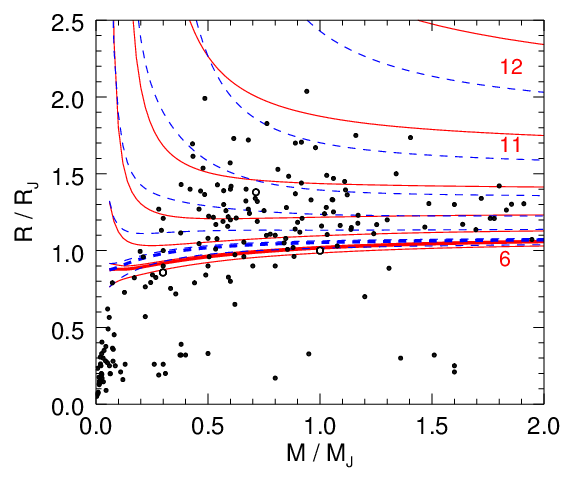
Figure 12 in Ref. [1] |
Using density
functional molecular dynamics simulations, we determine the equation of
state (EOS) for hydrogen-helium mixtures spanning
density-temperature conditions typical of giant planet interiors. In
our manuscript [1], a comprehensive equation of state table with 391
density-temperature points is constructed and the results are presented
in form of two-dimensional free energy fit for interpolation. This web
page was setup togive everyone access to our EOS points, the coefficients of the free energy fit, and our free energy interpolation code, which is currently written in Fortran 77. A C++ version could be constructed if there is sufficient demand. Three files are available: |
Simulation Data

Temperature-density conditions were DFT-MD simulations were performed (figure 1 in Ref. [1]) |
Comments: This table contains the pressure, internal energy, entropy, and free energy from our ab initio simulations a hydrogen-helium mixture of a solar-type composition with 18 helium in 220 hydrogen atoms. The helium mass fraction is Y=0.245.
The density parameter rs is given by 4/3*pi*rs3=V/Ne where Ne is total number of electrons (bound and free) in volume V. The number density of electrons is n=Ne / V. Limitations: In density, the fit ranges from rs=3.581
to 0.526 [0.06696 ... 19.97757 g/cc, log10(density)=–1.1742 ... 1.3005]. So an alternative EOS table is
needed to model the outer envelop of a giant planet where the H-He
mixture is at a lower density. |
Available Files
| Date | Description | Download |
|---|---|---|
| 01-29-13 | Fortran 77 code that prints a number of EOS points based on the free energy interpolation | eoshhe_01-29-13.f |
| 01-29-13 | Output of EOS code | eos.out |
| 01-29-13 | Very similar Fortran 77 code that prints the adiabats rather than the EOS points | adhhe_01-29-13.f |
| 01-29-13 | Output of EOS code | ad.out |
| 01-31-13 | Machine readable table of the original EOS points derived from DFT-MD simulations | EOS.txt |
| 01-31-13 | Machine readable table of the 2D spline coefficients | EOS_fit.txt |
Compilation Instructions
Example compilation using GNU Fortran:
gfortran adhhe_01-29-13.f -o ad
 ad > my_ad.out
Compare my_ad.out with the provided ad.out.